What is Early Intervention?
Early Intervention is a supportive programme and therapeutic curriculum that helps children with developmental delays, unique learning and behavioural challenges. It is designed for preschool-aged children who need further support to develop their language and communication skills, increase their sensory integration, enhance their fine and gross motor skills, build their foundation in academic skills, and improve their social skills. It is designed to assist children in developing the core life skills required to join their mainstream peers in Singapore’s formal education system.
Developmental milestones are core skills infants or toddlers should be achieving month by month gradually. These core skills can be broadly classified into the motor, sensory, language, cognitive, and social skills. When a child has difficulty achieving these milestones or achieves these milestones at a slower pace, it is known as Global Developmental Delay.
Parents should start Early Intervention as early as possible as it is likely to be more effective in the early stages of a child’s life compared to receiving it in his later years. Early detection is crucial for providing timely and effective intervention, enabling your child to receive targeted support in essential areas of development.
At Bridging the Gap, our team of early intervention professionals, including therapists and learning support educators, conducts thorough assessments to understand your child’s unique needs. From there, we create a personalised programme plan, designed to address specific developmental goals and support their growth in a structured, compassionate environment.

Bridging the Gap’s Early Intervention Programme
Our Early Intervention Programme in Singapore encompasses multidisciplinary services such as Child Speech Therapy, Occupational Therapy, Educational Therapy, Social Skills Training, Multi-sensory and Preschool Readiness Activities to help young children with special needs develop their potential and overcome their developmental delays.
Our programme aims to ensure that each child’s strengths and challenges can be addressed and to help them reach their goals in terms of their daily living skills, functional skills and social thinking skills.
Our Early Intervention Programmes include the following Core Features and Goals:
- Addresses each child’s strengths and challenges, targeting daily living, functional, and social thinking skills.
- Suitable for Preschool-aged children who cannot access mainstream preschool settings.
- Provides specialised instruction in small teacher-student ratios.
- Offers a 3 or 5 day intensive programme at a Private Early Intervention Centre in Singapore to help your child achieve key developmental milestones.
- Structured support to address developmental needs and improve behaviours.
- Utilises multi-sensory activities and materials to enhance learning for children with learning difficulties.
- Targets multiple senses (touch, sight, hearing, smell, and taste) to aid children with developmental delays effectively.
- Regular evaluations and adjustments to refine teaching strategies based on progress.
Our early intervention approach integrates support into your child’s daily routines and natural environments. Using a transdisciplinary team model, early interventionists, therapists, and educators work together to empower families.
This ensures parents and caregivers have effective tools to actively support their child’s development in familiar, meaningful settings.


How Can Our Early Intervention Programme Help Your Child?
The key difference between Bridging the Gap’s Early Intervention Programme compared to other intervention programs lies in our teaching methodology. We understand that every child learns differently, and we need to develop customised teaching plans which cater to individual learning needs. Instead of using a one-size-fits-all teaching plan, we embrace a student-centered learning philosophy, ensuring that your child learns in the best way he can.
Through our intensive intervention curriculum, we help your child develop the core skills required to join mainstream schools in Singapore’s formal education system.

5 Key Focuses of Our Early Intervention Programme

Children with developmental delays struggle to manage sensory inputs. Our therapists create personalised sensory diets, incorporating various sensory inputs like proprioceptive, tactile, visual, auditory, vestibular, gustatory, and oral motor to enhance learning.
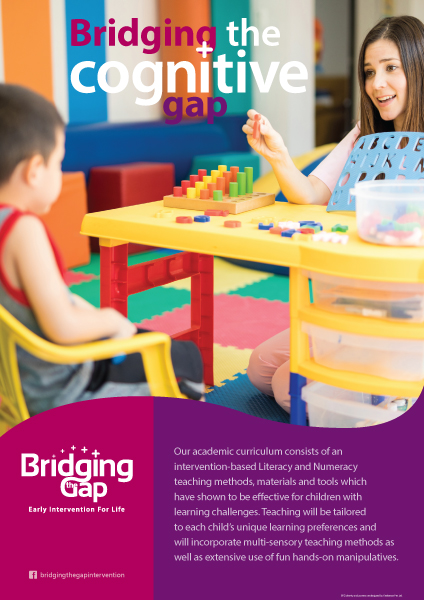
Our Early Intervention curriculum offers tailored Literacy and Numeracy teaching methods, alongside multi-sensory techniques and hands-on activities to boost cognitive skills such as reading, writing and logical problem-solving. The individualised programme plan is based on each child’s preferences and needs.
Children develop social skills to foster positive relationships with loved ones. Our structured teaching methods and therapies promote desired behaviour and positive verbal & non-verbal interactions, enhancing self-confidence and communication effectively.
Social and emotional development includes children’s awareness of their own and others’ emotional needs. We offer effective emotional support by acknowledging and helping children manage their emotions (especially negative feelings and meltdowns) and in building self-esteem. A nurturing, accepting environment is essential for fostering healthy emotional well-being in your child.
At Bridging the Gap, we believe every child is a precious gift from God. Our customised programmes aim to enhance children intellectually, relationally, emotionally, and physically, rooted in Christian values to nurture strong character. We affirm each child, empowering them to positively impact society as valued individuals.
Signs of Developmental Delay
Although every child develops at his own pace, it is important to be aware of some red flags for potential developmental delays. Minor or temporary delays are no cause for alarm. However, an on-going delay or multiple developmental delays can implicate future challenges in life and require early intervention.

There are many developmental delays young children may experience. They include:
- Difficulty in speech and language
- Difficulty in problem-solving / logical reasoning
- Trouble with learning in school
- Difficulty in communicating / socialising with others
- Unable to walk, crawl, sit up or roll
- Limited motor skills
- Unable to get dressed on his own
- Poor vision / perception skills
If your child faces these developmental delays, it is critical to enrol your child in an Early Intervention Programme as early as possible as a child’s brain is primed for adapting and learning in the first 3 years of his life. Speak with us to understand how you can better support your child’s development.
Our Process: Steps Involved in Our Early Intervention Programme
Step 1: Assess Your Child’s Needs
Bridging the Gap conducts thorough assessments to understand each child’s unique strengths and challenges. This comprehensive evaluation identifies learning needs and opportunities, enabling tailored interventions to bridge learning gaps effectively.
Step 2: Formulate an Early Intervention Plan
Based on assessment results, we create a comprehensive early intervention plan addressing all aspects of your child’s development: cognitive, social, and emotional. This customised plan aligns with your child’s learning needs and goals, providing tailored support at the appropriate level.
Step 3: Enrol in Integrated Early Intervention
At Bridging the Gap, your child receives integrated early intervention, enhancing language, communication, fine and gross motor skills, and social skills all in one class. You’ll also gain intervention strategies to support your child’s development and adaptation in various settings and at home.
Step 4: Receive Home Exercise Tips Weekly
Bridging the Gap provides home exercise tips for you to integrate into your child’s daily routines, fostering learning and development. Engaging in these exercises together helps your child practice skills in various contexts and strengthens your bond.
In-House Sensory Gym Facilities for Early Intervention Therapy Classes
Bridging the Gap centres are fully equipped sensory gym with over 2,000 sq ft space with trampolines, slides, swings and trikes. Our gyms and classrooms are thoroughly sanitised every day, after every class session.


Locations of Our Early Intervention Centres
Currently, we have 3 branches of early intervention centres in Singapore. Located in the Central areas (Farrer Park / Kitchener Rd), located in the West (Rochester / Buona Vista), and located in the East (Marine Parade / Katong) of Singapore.
Bridging the Gap
@ Marine Parade
80 Marine Parade Road,
#19-03 Parkway Parade,
Singapore 449269
Bridging the Gap
@ Buona Vista
The Rochester Mall
35 Rochester Drive, #03-26
Singapore 138639
Bridging the Gap
@ City Square Mall
City Square Mall
180 Kitchener Road, #08-06,
Singapore 208539
Intervention Class Schedules
We offer a weekly 3-day, 4-day or 5-day programme to suit your needs. Bridging the Gap has a morning session running 9am – 12pm, and an afternoon class running 2pm – 5pm.
Programme Information: Sample of Daily Timetable
| Time | Programme |
|---|---|
| 9.00am – 9.15am | Sensory Play |
| 9.15am – 9.45am | Circle Time |
| 9.45am – 10.30am | Literacy & Language Intervention |
| 10.30am – 10.50am | Snack Time & Toileting Routine |
| 10.50am – 11.10am | Fine Motor Activities / Arts & Crafts |
| 11.10am – 11.30am | Numeracy |
| 11.30am – 11.50am | Sensory Gym (Occupational Therapy Activities) |
| 11.50am – 12.00am | Circle Time (Social stories, Goodbye Song) |
Parent Testimonials
My son joined the early intervention programme at Bridging the Gap (City Square Mall) at the end of June this year and since then he has made great progress in such a short space of time.
All the teachers are great and kind – dealing with children with special educational needs is challenging (I can really say that as a father of such a child) but the teachers at Bridging the Gap really put in a lot of effort to help these children and they are so dedicated.
I truly believe that they don’t just see it as a “job” but really want to “bridge the gap” for a better life for their students. I am grateful for their support in my son’s development.
Eric Huang

Transferred my son from Government EIPIC to BtG half a year ago and he has equally made good progress with better communication and cognitive skills. He can blend in the BtG family and enjoyed the circle time, table work, sensory play and therapy sessions etc.
I personally love the parent-teacher communication book which records his involvement at respective activity segments and how he fared every lesson.
The teachers are patient and responsive and the centre Director, Janice, is very helpful in providing useful tips on how to manage the kids especially when they turn emotional. I am working closely with the centre now to enhance his readiness for mainstream primary school and hope he can be enrolled successfully.
Thank you for the guidance and support, BtG.
Evon Ho
BtG is a great early intervention centre with amazing teachers who are very dedicated to their job. You can see their passion for children, and they are genuine in helping all the special needs children.
My daughter has been attending BtG for about 1.5 years now. She has made a lot of improvements in terms of speech, motor skills, behaviour and many more. She always looks forward for her classes at BtG. Whenever she is unwell, she will feel sad just because she is unable to attend class. That’s how much she loves going to BtG!
Highly recommend BtG if you’re looking for an early intervention centre!
Zaki
Conveniently located nearby Buona Vista MRT, my son has been with BtG for more than a year and attends the 3 hrs session for 3 days a week. Before BtG, he was non-verbal however, it is testament to BtG’s team’s passion, love and care for my son that he has thrived and evolved into this cheerful boy of many words, even loves to sing!
The school is equipped with its own sensory gym and includes all the necessary therapy methods that are required for your specific child. The school can also link with other schools if your child attends other schools, this ensures seamless and thorough transitioning to and from the schools. Recommended 100%.
Rendi
My child enjoys going to classes at BtG and we see improvement in his self-regulation and negative behaviours. The teachers are proactive, charged up and happy every check in and we can see the kids are happy to dash into the centre each time.
Last but not least, Centre Owner Ms Janice is heavily invested in each child. She takes her time off to meet each child and their parent.
Nately Tan
The teachers are awesome, dedicated, loving, genuine and a gift from the almighty for my baby Kayla♥️ They never fail to know each individual child’s name and their energy is awesome🙌.
Always willing to help me when I enquire on issues I have with Kayla. May God bless all of you with happiness and good health always. Thanks for being part of our lives🥰🥰
Sharmila Hashim
Bridging the Gap has been incredibly supportive in helping Rayner overcome his development challenges, especially with his speech difficulties. The teachers are caring, attentive, and always create a nurturing environment for him.
A special thanks to Teacher Janice, who has been so encouraging and always offers valuable advice on how to support Rayner’s speech and learning progress. We are very grateful for all their dedication and support!
Kristine Toh
When we became aware that our girl needed more support in her development, we immediately looked around for an EIPIC centre for her. One of the centre I visited was BtG.
I spoke with Janice about my concerns for my girl during my visit and she provided some suggestions to aid in her development.
The team at BtG are dedicated and patient with my girl. Now into her 9th month at BTG, she had made vast improvements in her speech and communication skills.
Thanks to the team at BtG.
Jasmine Lin
I found Bridging the Gap (BtG) based on glowing recommendations from fellow parents. Since then, my encounters with BtG have been nothing short of positive.
After nearly half a year with them, I can confidently say that my children have thoroughly relished every lesson with the teachers at this institution, and their advancement has been truly remarkable.
I am immensely grateful to Teacher Janice and Teacher Max for their attentive care and dedication. I am optimistic that my children will have a solid foundation for their next milestone in life.
Corinne Tan
Early Intervention Programme
Administration Information
Who is Eligible to for our Early Intervention Programme in Singapore?
This programme is ideal for children requiring targeted, individualised therapeutic support to reach key developmental milestones and for families seeking a consistent, customised approach to ongoing intervention.
- Age Range: 18 months to 8 years
- Displays signs of development delay, has yet to be diagnosed by a registered public health doctor or private paediatrician.
- Has a specific health condition that will probably lead to a delay (e.g. genetic disorders, birth defects, hearing loss).
- Is diagnosed with mild to severe developmental, intellectual, sensory, physical, or multiple disabilities.
- Has been recommended for early intervention by a registered public health doctor or a private paediatrician.
Begin your journey with our Individualised Early Intervention Programme and Curriculum to empower your child to achieve their goals, develop essential skills, and confidently tackle learning challenges.
What are the Admission Criteria and Details of the Programme?
All children must undergo an initial assessment to determine their individual needs and areas of support. The assessment evaluates key developmental areas, such as sensory processing, emotional regulation, social skills, literacy and numeracy levels, and overall learning style.
Based on the assessment results, a customised support plan is created to ensure the programme aligns with the child’s specific requirements and goals.